
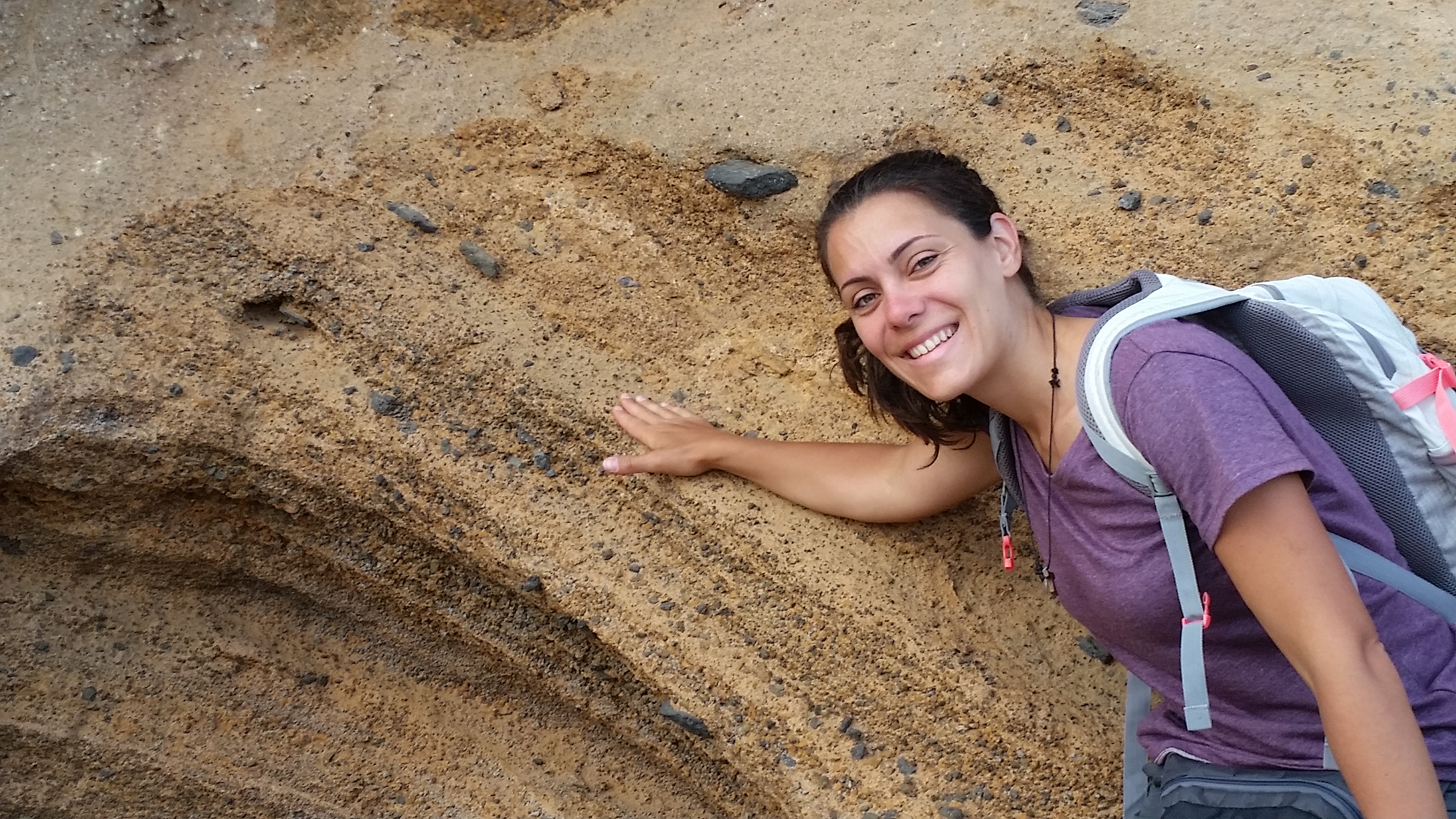
Personal Data
Address: Via Montegrappa 10, Pontecagnano Faiano (SA), 84098, Italy
Date of Birth: 08th November 1984
Place of Birth: Battipaglia (SA), Italy
Family Status: Single
Nationality: Italian
Tel: 0039 3495698354
E-mail: valentina.carleo@phd.unict.it ; valecarleo.phdunict@gmail.com ; valeeffo@pec.it
Personal Profile
After earning a Bachelor's degree in Geological Sciences and a Master's degree in Geophysical Sciences, focusing on research related to Volcanology and natural hazards, and after several years of teaching in upper secondary schools, I decided to return to my studies to pursue my true passion: research in the field of geology. Although my path has not been linear, each step has led me here with determination, maturity, awareness and initiative, always keeping in mind the goal that I truly feel is mine: to actively contribute to scientific research through my work and skills.
Research interests
▪ Contribute to the development of operational tools for volcanic risk management by multidisciplinary approach, integrating field and monitoring data with probabilistic assessments and effective communication approaches.
▪ Apply innovative multi-risk digital techniques for volcanic risk analysis (numerical analysis, probabilistic modeling)
▪ Assessment of volcanic risk and perception risk in active areas
▪ Geophysical, geochemical, satellite monitoring and emergency plan in volcanic risk areas
▪ Geophysical methods applied to volcanology
▪ Methods for assessment of physical parameters concerning explosive eruptions
▪ Geological and stratigraphic recognition of deposits of explosive eruptions
Education
▪ Teaching Qualifications
- Jun 2025: Teaching Qualification in Science A050 for Secondary School Education – Grade: 10/10 – Pegaso Online University, Italy - 30 CFU (Credit Points) program DPCM August 4, 2023 for obtaining the teaching qualification in Science (A050), following innovative methodologies with the IBSE (Inquiry-Based Science Education) approach.
- Jan 2025: Teaching Qualification in Physics A020 for Secondary School Education – Grade: 10/10 – University of Naples Federico II, Italy - 60 CFU (Credit Points) program DPCM August 4, 2023 for obtaining the teaching qualification in Science (A050), following innovative methodologies with the IBSE (Inquiry-Based Science Education) approach.
▪ University
- October 2025 – Present: PhD in Earth and Environmental Sciences, University of Catania, Department of Biological, Geological and Environmental Sciences; Project title: KLARA - Kinetics of Lava Flows Crystallization; Supervisor: Prof. Gabriele Lanzafame.
- Dec 2024: Master’s degree in Geophysics sciences, University of Naples Federico II, Italy – Grade: 110 with honors / 110. In particular, focusing on Geophysics of Seismic and Volcanic risks, Geophysics data analysis and inversion, Potential field-methods in Geophysical exploration EM and Seismic methods, Physics of Geodynamic processes.
Dissertation:
Title: “Perception of volcanic risk in the population of the municipalities in vesuvian red zone”
Written at: Institute of Geophysics, University of Naples Federico II, Italy
Supervisor: Professor Claudio Scarpati
Description: Qualitative assessment of volcanic risk perception among shopkeepers (middle class) and lower and upper secondary school students living in the Vesuvius red zone (Torre del Greco, Portici, Cercola, Pollena, San Giuseppe Vesuviano), based on the administration of 4,189 questionnaires in 2009 and 2,451 in 2024, with a temporal perspective. The questionnaires were designed to evaluate various aspects, including knowledge of volcanic processes and related hazards, preparedness and behaviour, vulnerability and risk perception, education, access to information, trust in institutions, self-efficacy, forecasting, early warning, evacuation, and perceived responsibilities. The thesis was partially carried out in collaboration with the Department of Geography, Environment & Disaster Management at Coventry University, UK, and with the support of local authorities in the red zone, particularly the Sportello Vesuvio in Torre del Greco, and territorial institutions such as the Regional and Local Civil Protection, Municipal Police, and the Naples and Municipal Port Authorities.
- Jun 2007: Bachelor’s degree in Geological sciences, University of Naples Federico II, Italy – Grade: 110 with honors / 110. Bachelor thesis in Physics of Volcanoes and final year specialization in Geophysics, in particular focusing on Physics and Chemistry of Volcanic Fluids, Geology and Geophysics of Dynamic active areas, Geochemistry and Volcanology, Mineralogy and Petrography, Structural geology.
Dissertation:
Title: “Assessment of physical parameters concerning explosive eruptions: Magnitude of Vesuvius eruptions”
Written at: Institute of Geology, University of Naples Federico II, Italy
Supervisor: Professor Claudio Scarpati
Description: Calculation of fall deposit volumes for major eruptions of Mount Vesuvius through area-based methods (trapezoidal, simple numerical integration) that relate deposit thickness to the area enclosed by isopachs. The aim is to identify the most effective methodology, using the methods of Cole & Stephenson (1972), Rose (1973), Walker (1980), Froggatt (1982-1992), Pyle (1989-1995), and Fierstein & Nathenson (1992).
▪ School
1998–2003: A–levels, Scientific High School, Salerno, Italy, Physics (A), Mathematics (A), Further mathematics (A) – Grade: 100/100.
Publications and Conferences
▪ Conference: Geophysical Research, EGU General Assembly 2019, Vienna, Austria. Contribution: Poster – Diffuse CO2 degassing surveys for volcano monitoring of the North-South Rift Zone (NSRZ) volcano, Canary Islands. Claudia Rodríguez-Pérez, Daniel J C Manns, Valentina Carleo, Mar Alonso, Fátima Rodríguez, María Asensio-Ramos, Gladys V. Melián, Eleazar Padrón, Pedro A. Hernández, Nemesio M. Pérez.
▪ Conference: International conference Cities on Volcanoes -Tenerife 2010 Session 2.3 "Education and Outreach for Reducing Volcanic Risk.". Tenerife, Canary Islands, Spain May 31 to June 4, 2010 - Contribution: Talk, presented by Simone Lepore on behalf of Scarpati Claudio and Carleo Valentina - Volcanic Risk Perception In The Towns Around Mt. Vesuvius. Scarpati Claudio, Carleo Valentina, Catalani Mauro, Cole Paul, Di Donna Gennaro, Lepore Simone, Perrotta Annamaria, Pilley Vanessa.
▪ Participation as a student in the Seminar: “Nyiragongo and Nyamuragira, the most active volcanoes of Africa: activity and emergency plan”, held by professor Dario Tedesco, Department of Science and Environmental Technologies, II University of Naples, on 11-06-2015.
▪ Missionary seminar held by myself and the missionary group in Congo in October 2009, in the municipality of Portici for high school students, following the missionary experience in the Democratic Republic of the Congo. The seminar aimed to raise awareness among students about developing countries, their right to reclaim their freedom and humanity, and their responsibility to build their future (resilience), through information, education, and culture.
▪ Book: Un sacco di Ingiustizie. Esperienze e riflessioni di giovani in Terra d’Africa. Giorgio A. Pisano, Sébastien Sasa Nganomo Babisayone, Valentina Carleo et al. 2010, Edizioni Creativa. The proceeds was fully devolved to build the structure “Agorà – Kinvuka” in the district of Kikwit 4 in RDC, for information, formation and culture of young people.
Scientific Cooperations
2014: Submission of the questionnaire, repurposed on the model of Vesuvius questionnaire, about volcanic risk perception to people lives in Goma, RDC, for the presence of two active volcanoes, Nyiragongo and Nyamuragira, in a land which suffers a difficult socio-economic climate, but looking for autonomous development (resilience) and it’s subject to several risks, as war, poverty, violations of the human rights, as well as the volcanic risk. This research was done in collaboration with professor Dario Tedesco, Department of Science and Environmental Technologies, II University of Naples, and the International Organization for Migration (OIM).
Field work experience
Jun 2014: Training course for outreach activities in the Stromboli and Vulcano Information Centers at the Department of National Civil Protection, Rome, getting the certificate of participation.
Nov 2014: Excursion to Pollena little cones - Geological-lithological recognition of the structures, construction of geological sections and type of eruptive activity, according to the exposed deposits.
Mar 2007: Excursion to the archaeological excavation of Pollena - Study of the deposits of Vesuvius eruptions (472 AD, 512 AD) which covered a Roman thermal building and damage analysis.
Feb 2007: Excursion to the Somma-Vesuvius volcanic complex - Geological and stratigraphic recognition of deposits of the Somma-Vesuvius complex eruptions for the cone and the Hell Valley.
Feb 2007: Geo-archaeological excursion at the Pompeii excavations - Geological and stratigraphic recognition of the 79AD deposits that covered the house of Giulio Polibio; this research was conducted in collaboration with Professor Paul Cole of Coventry University, UK, and professor Claudio Scarpati of the University Federico II of Naples.
My own trip experiences
Nov 2016: Excursion to La Palma island, Canary Islands, visiting the Taburiente Caldera and Roque de los Muchachos,the GranTeCan and San Antonio and Teneguia volcanoes. Excursion to Tenerife island, trekking on Pico del Teide and Pico Viejo and visiting the lava tube in Icod de los Vinos and Astronomical observatory of Teide.
Sep 2014: Excursion to La Palma island, Canary Islands, visiting the northern area of the Taburiente Caldera, towards the "Barranco de Las Angustias” and the "Cascada de Colores", the Cumbrecita and the "Roque de los Muchachos" (highest point of the caldera at 2426 m), where it was possible to visit the largest telescope in our hemisphere, the GranTeCan. In the central and southern part of the island I had done trekking on Cumbre Vieja, San Antonio and Teneguia volcanoes.
Aug 2009: Missionary experience during one month in the Democratic Republic of the Congo, west of the country, for a humanitarian mission, in particular in Kinshasa and in the Kikwit, Bulungu, Soa villages. Above all, the mission was based on the interrelationship between two peoples of different cultures and then on the meeting with young people for a cultural exchange made before in Congo and then in Italy, thanks to the Youth Policy Department of the Campania Region.
Jun 2006: Mount Etna Excursion - Group excursion to Mount Etna, starting from the refuge at 1000m altitude and trekking on the Bove Valley, going up to the eruption vent at 3330m altitude.
Vocational Experience
2025-2026 (currently on leave for PhD studies): Teacher of Physics A020 – IIS Basilio Focaccia, Salerno (SA), Italy - Sector: Social and Educational Services
2023-2025: Teacher of Integrated Sciences A050 - Kennedy Private Institute, Pontecagnano Faiano (SA), Italy - Sector: Social and Educational Services
▪ Classroom management to maintain a positive learning environment for all students
▪ Lesson planning and preparation according to ministerial standards, with creative and innovative development to engage students in learning
▪ Participation in educational workshops for the learning of Applied Sciences
▪ Organization of individual and group activities based on students' learning needs
▪ Formative assessment and monitoring of student performance to provide feedback aimed at improving learning outcomes
▪ Summative assessment of students through tests and oral examinations
▪ Collaboration with colleagues from academic and support subjects to provide an interdisciplinary, safe, and supportive learning environment
▪ Collaboration with parents and tutors to ensure student success
Sep 2018: Geochemical training at the Canary Islands Volcanological Institute, InVolcan (Spain), on diffuse volcano degassing monitoring at the Tenerife NSRZ volcano; the training concerned in-situ surface CO2 efflux measurements, collection of soil gas samples for chemical and isotopic analysis, application of statistical-graphical analysis on the diffuse degassing data, estimation of the diffuse CO2 emission from Tenerife NSRZ volcano using Gaussian simulations, chemical analysis of the collected surface gas samples by means of microchromatography (microGC) e quadrupole mass spectrometry (QMS).
Aug 2015: Volcanological Guide at INGV Vulcano’s Operative Center (Aeolian Islands, Italy) - Experience of outreach activities for visitors of the Vulcano Island, by providing scientific information about this volcano and Aeolian volcanic arc, as well as basic concepts of volcanology.
Miscellaneous
▪ Digital skills
Operating Systems: Linux, Mac OS X, Windows
Programming Languages: Python (basic), LaTeX, S, Matlab
Data Analysis / Graphic Software: R, Mathematica, Origin, Gnuplot, Surfer
Certifications:
• European Informatics Passport Eipass Standard - Digital Competence Framework for Citizens - DigComp 2.2, Intermediate Level; Accrediting Body: Accredia; Certification Body: Certipass
• Eipass CODING Secondary, Intermediate Level; Accrediting Body: MIUR; Certification Body: Certipass
• Eipass LIM, Advanced Level; Accrediting Body: MIUR; Certification Body: Certipass
• Eipass TABLET, Advanced Level; Accrediting Body: MIUR; Certification Body: Certipass
• Professional Training in Typing, Pitagora Training Center (NA)
▪ Language Proficiency
Italian: Fluent
English: Basic
The aim of this research is to investigate the crystallization and degassing of silicate melts under subaerial conditions. Large, destructive effusive eruptions are mainly fed by basic lavas capable of flowing for tens of kilometers, causing significant damage to public and private infrastructure before the increase in viscosity eventually halts their advance.
The areal extent of lava fields is controlled by lava viscosity, which in turn is regulated by syn-eruptive crystallization and gas loss. Since these processes cannot be directly observed in naturally flowing lavas, their investigation must be carried out through laboratory experiments. This study will combine field investigations and laboratory experiments focusing on effusive eruptions in several predominantly basaltic volcanic systems (Sicily, Hawaii, the Canary Islands, and Chile).
Targeted field surveys will be conducted on specific lava flow units and/or lava fields in order to obtain high-precision mapping and to estimate the volume of erupted products, particularly in volcanic settings where such information is not available in the literature or is affected by a high degree of uncertainty. Representative lava samples will be selected and characterized using geochemical and petrographic techniques, including optical and electron microscopy (thin-section analysis under a polarized light microscope and scanning electron microscopy, SEM). The timing and sequence of crystallization will then be investigated through high-temperature 4D X-ray computed microtomography experiments, allowing real-time determination of crystal growth rates under variable cooling rates and volatile contents.
Finally, the evolution of lava viscosity will be modeled using a viscometer and established rheological methods available in the literature. During the six-month research period abroad, chemical analysis techniques on mineral phases using an electron probe microanalyzer (EPMA) and high-temperature 4D X-ray computed microtomography experiments will be further refined. This period will also provide opportunities to participate in scientific conferences and to develop international research collaborations.
The results will improve our understanding of the degassing–cooling–crystallization processes in lava flows and will allow reconstruction of the rheological evolution during lava emplacement. Furthermore, they will contribute to improving predictions of lava flow length during large effusive eruptions, with important implications for hazard assessment in volcanic areas characterized by a high risk of lava flow.